28th United States Colored Troops

War Department General Order 143 officially created the Bureau of Colored Troops on May 22, 1863. Maj. Charles Foster was put in charge of recruitment, training, placement of troops and officer selection.[1] At the beginning of the war, offers to recruit troops of color had been refused, but after 1862 and the Emancipation Proclamation, liberation of enslaved people became a stronger driving force of the war.[2] Allowing African Americans to enlist also helped states meet their enlistment quotas, which became more difficult to do as the war went on. Gov. Oliver P. Morton wavered on whether to recruit black troops in Indiana for political reasons – one of the main risks being that as a border state the outcome could result in losing Union support from Hoosiers in the southern part of the state.[3] Prior to the official order, it wasn’t uncommon for black men to leave their home states to enlist in states where they could fight.[4] On Nov. 30, 1863, Morton finally gave the order to form a regiment of black troops in Indiana, one of the few black regiments formed in a Northern state, the 28th United States Colored Troops was born.[5]
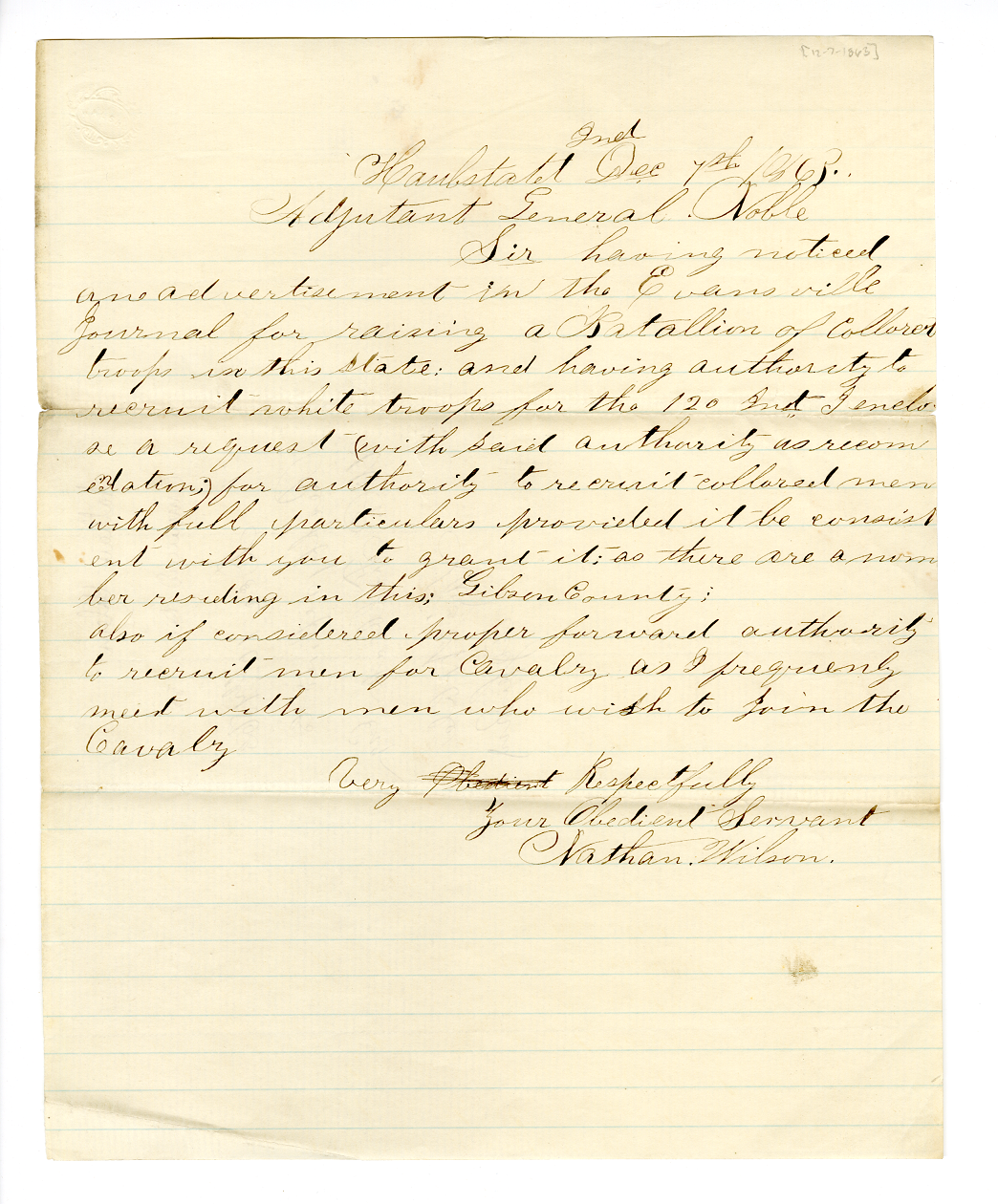
Nathan Wilson letter to Adj. Gen. Lazarus Noble, Dec. 7, 1863, L548 Anna W. Wright collection, Rare Books and Manuscripts, Indiana State Library.

The 28th USCT departed Indianapolis for Virginia in April of 1864 to a positive reception from the local press. They were assigned to the Fourth Division of the Ninth Corps – part of the Army of the Potomac – under Maj. Gen. Ambrose Burnside and commanded by Gen. Edward Ferrero.[6] From there, they were involved in some of the most famous events of the Civil War, including the Petersburg Campaign, Battle of the Crater and the fall of Richmond. On their way toward Petersburg, they were involved with a number of skirmishes which allowed them the chance to prove their mettle amongst the other troops, both boosting morale and reputation. In summer of 1864, the Army of the Potomac planned another siege on Petersburg with most of the existing troops exhausted from weeks on end of combat. This situation left the Fourth Division in a position to lead a charge that could potentially end the war. It was also, unfortunately, the ill-fated Battle of the Crater.[7]
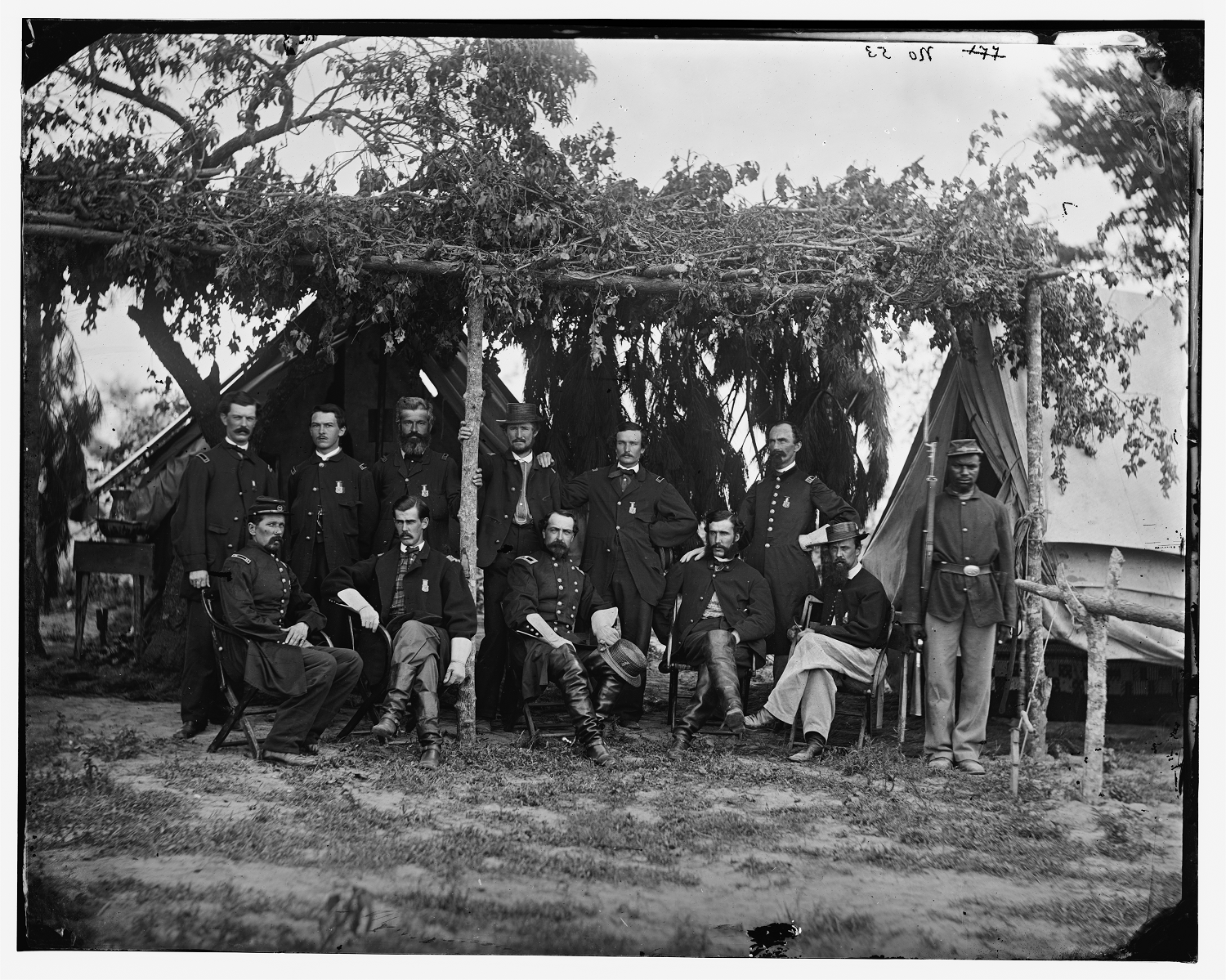
Petersburg, Virginia. Gen. Edward Ferrero and staff photograph. 1864, Sept. From Library of Congress: Civil War photographs, 1861-1865. Accessed Feb. 27, 2020.

The Battle of the Crater was supposed to clear the road to Richmond and the end of the War. The Fourth Division had trained for weeks while others dug a mine shaft underneath a Confederate fort where explosives would be utilized to commence the battle. Less than 24 hours before the anticipated explosion, Maj. Gen. George Meade told Burnside to have one of his white divisions lead the charge instead. This decision was backed up by Lt. Gen. Ulysses S. Grant.[8] The morning of July 30, 1864 was riddled with snafus including communication errors, delays and issues lighting the fuse on the explosives. By the time the Fourth Division entered battle, two hours after it had commenced, there was a veritable bloodbath in the crater that was left behind by the explosion. Leading Union troops were unable to climb out of the crater. The black troops charged forth gallantly into the battle with valor that none could deny, but met a storm of bullets from Confederate troops and few white soldiers were willing or able to back them up.[9] With African American troops officially part of Union forces, the Confederate soldiers fought with increased fury and atrociousness. Massacre of black soldiers trying to surrender was commonplace and very few black soldiers were taken prisoner.[10] Reports of the losses of the 28th USCT from the Battle of the Crater vary, but have been noted to be between 40-50%, not including officers.[11] Afterwards, there was a Court of Inquiry looking into the calamity at the Battle of the Crater and Burnside was relieved of command. Racism is frequently brought up as a primary factor in the Fourth Division being re-assigned at the last minute before the Battle of the Crater. Burnside was the only leader who had faith that the black troops could succeed at the time. In the Court of Inquiry, blame was even placed on the Fourth Division for the chaos of the Battle of the Crater. It is clear that the USCT were never fully accepted as brothers in arms during the Civil War.[12]
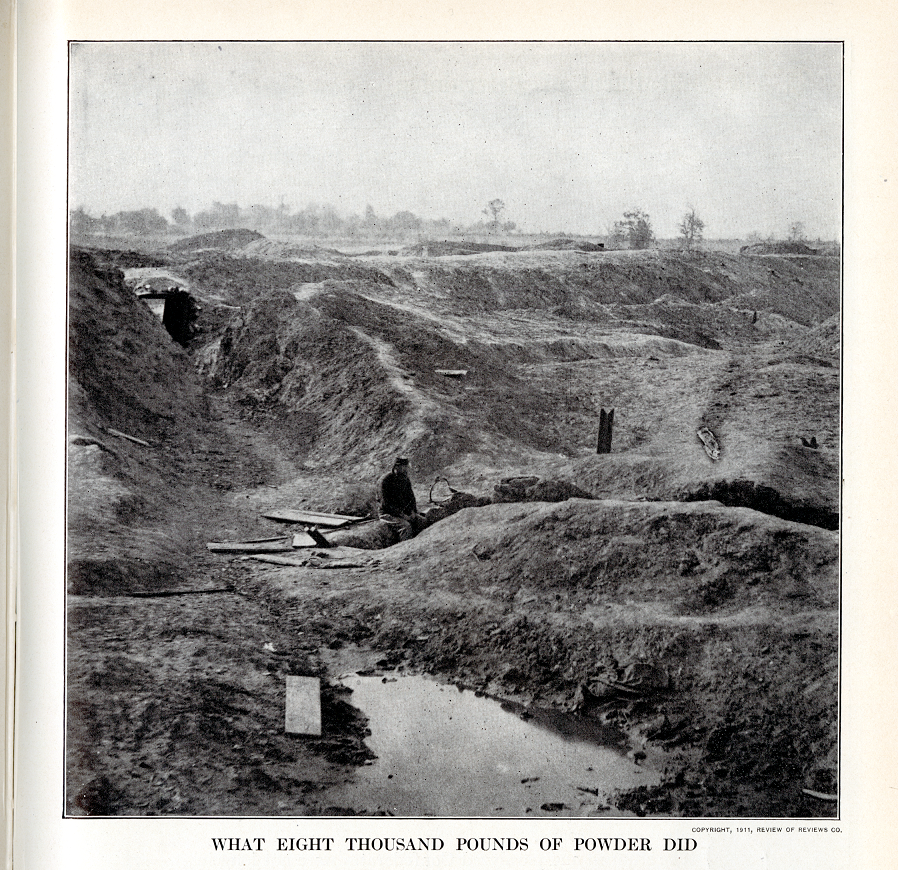
“What Eight Thousand Pounds of Powder Did” photograph. In Civil War, through the camera. McKinlay, c. 1912, p. 193.

After the Battle of the Crater, the 28th USCT was assigned to the Army of the James – as part of the 25th Corps they helped make up the largest formation of black troops in American history.[13] They weren’t put in active service until the spring of 1865 when they were moved to the front lines between Petersburg and Richmond.[14] On April 1, 1865, the Confederate government fled the city of Richmond. With the Army of Northern Virginia defeated, the road was clear for Union troops to march into the city. The 28th USCT advanced and was one of the first to enter Richmond at the end of the war.[15] After a brief stint in Texas, they were mustered out of service on Nov. 8, 1865.

This blog post was written by Lauren Patton, Rare Books and Manuscripts librarian, Indiana State Library. For more information, contact the Indiana State Library at 317-232-3678 or “Ask-A-Librarian.”

[1] Moore, Wilma L., “The Trail Brothers and their Civil War Service in the 28th USCT”, Indiana Historical Bureau. https://www.in.gov/history/4063.htm. Accessed February 13, 2020.

[2] Forstchen, William R., “The 28th United States Colored Troops: Indiana’s African-Americans go to War, 1863-1865”, Ph.D., diss., (Purdue University, 1994), p. 21, 36.

[3] Forstchen, p. 21.

[4] Ibid.

[5] Ibid., p. 8, 42.

[6] Ibid., p. 9.

[7] Ibid., p. 99.

[8] Williams, George W. A History of the Negro Troops in the War of the Rebellion, 1861-1865. New York: Harper, 1888, p. 244-245.

[9] Forstchen, p. 129.

[10] Ibid., p. 132.

[11] Williams, p. 250 and Forstchen, p. 146.

[12] Forstchen, p. 161-162.

[13] Ibid, p. 10.

[14] Ibid., p. 193.

[15] Ibid.
You joined what?! Not your average lineage societies

People choose genealogy as a hobby for many different reasons: to find out how an ancestor was involved in history, to explore family stories or to honor and preserve family culture and heritage. Some, however, pursue genealogy in order to join a lineage society.

What is a lineage society? A lineage society is a group that has requirements to join based on your ancestry. To join a society you will have an application to fill out, a membership fee to pay and you will need to provide genealogical documentation for your ancestor. Some lineage societies operate by invitation only.

To help a new potential member, many lineage societies will provide a list of qualifying ancestors on their web page.

A (very) brief history of lineage societies in the United States
After the American Revolution, Americans reveled in the newness of their country and rejected old world ways, including the elitism of genealogy and pedigree.

So, it should not be surprising that the first lineage societies, in what was to become the United States, were military based, such as the Ancient and Honorable Artillery Company of Massachusetts.

However, after the centennial celebration of the nation in 1876, Americans were eager to demonstrate their patriotism by showing their family involvement in the history of the nation. This resulted in the founding of the some of the best known genealogical lineage societies. For example, the Daughters of the American Revolution, founded in 1890, and the General Society of Mayflower Descendants, founded in 1897.

Today, for many Americans, the idea of a lineage society may be old-fashioned and stuffy, but that isn’t necessarily the truth. After the recent popular culture explosion of genealogy from the 1970s to present – where all ancestors of all types are celebrated – there is now a lineage society for everyone.

I hope you enjoy perusing some of the more unusual lineage societies I have discovered. Please visit the Genealogy Division of the Indiana State Library if you would like to explore your own curious lineage.

A Collection of Curious Lineage Societies
Associated Daughters of Early American Witches
This society was founded in 1987. A potential member must prove descent from an ancestor who was officially accused, tried, convicted or executed for the practice of witchcraft in Colonial America prior to 1699. The society website includes a list of qualifying ancestors.

Descendants of the Illegitimate Sons and Daughters of the Kings of Britain
This society was founded in 1950. A potential member must prove descent from an illegitimate child, grandchild or great-grandchild of a king of England, Scotland, Wales, Great Britain or the United Kingdom.

Flagon and Trencher
This society was founded in 1963. A potential member must prove descent from an individual who conducted a tavern, inn or ordinary in the American Colonies, prior to 1776. The society website includes a list of qualifying ancestors.

National Society of Saints and Sinners 
This society was founded in 2010. A potential member must prove descent from a saint. The society website includes a list of qualifying ancestors.

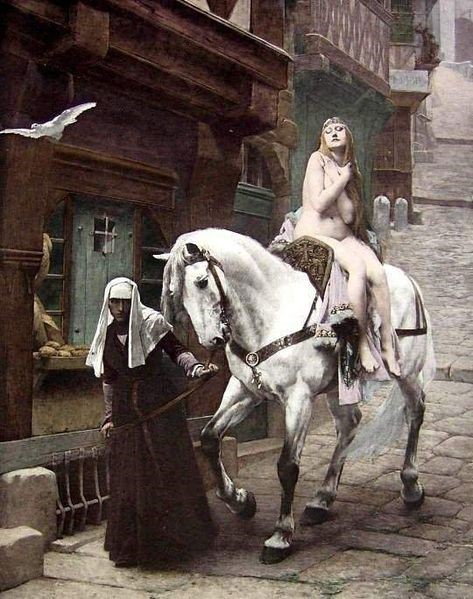
Society of Descendants of Lady Godiva
Established 2014, a potential member must prove descent from Lady Godiva. The society website includes a list of qualifying ancestors.

For more Information
The Hereditary Society Community of the United States

For further reading:
“The History of American Lineage Societies” by Kathy Petlewski, MSLS; Lineage Societies: Leaving a Legacy for Future Generations, by Kimberly Ormsby Nagy, MD, PLCGS; NGS Magazine April–June 2019, available in the Genealogy Division reading room.

“Your Guide to Lineage Societies” by Lynn Betlock, American Ancestors, vol. 19, Summer 2018, available in the Genealogy Division reading room.

“Family Trees : a History of Genealogy in America” by François Weil. ISLG 929 W422F. Genealogy Division, Indiana State Library.

“Roots Quest: inside america’s genealogy boom” by Jackie Hogan. ISLG 929 H7148RO. Genealogy Division, Indiana State Library.

For further research:
“Witches, Rakes, and Rogues: true stories of scam, scandal, murder, and mayhem in Boston,1630-1775,” by D. Brenton Simons. ISLG 974.402 B747si. Genealogy Division, Indiana State Library.

“Tracing Your Ancestors from 1066 to 1837: a guide for family historians,” by Jonathan Oates. ISLG 929.12 O11tr. Genealogy Division, Indiana State Library.

“A Who’s Who of Your Ancestral Saints,” by Alan J. Koman. ISLG 929.102 K81W. Genealogy Division, Indiana State Library.

“Magna Carta Ancestry: a study in colonial and medieval families,” by Douglas Richardson. ISLG 929.72 R522m. Genealogy Division, Indiana State Library.

“Plantagenet Ancestry: a study in colonial and medieval families,” by Douglas Richardson. ISLG 929.12 R522p. Genealogy Division, Indiana State Library.

“The Taverns and Turnpikes of Blandford, 1733-1833,” by Sumner Gilbert Wood. ISLG 974.402 B642W. Genealogy Division, Indiana State Library.

“A Sketch of Fraunces’ Tavern and Those Connected with Its History,” by Henry Russell Drowne. [Pam.] ISLG 974.702 N567 NO. 1. Genealogy Division, Indiana State Library.

This blog post is by Angi Porter, Genealogy Division librarian.

Check out recent Testing and Education Reference Center updates available via INSPIRE

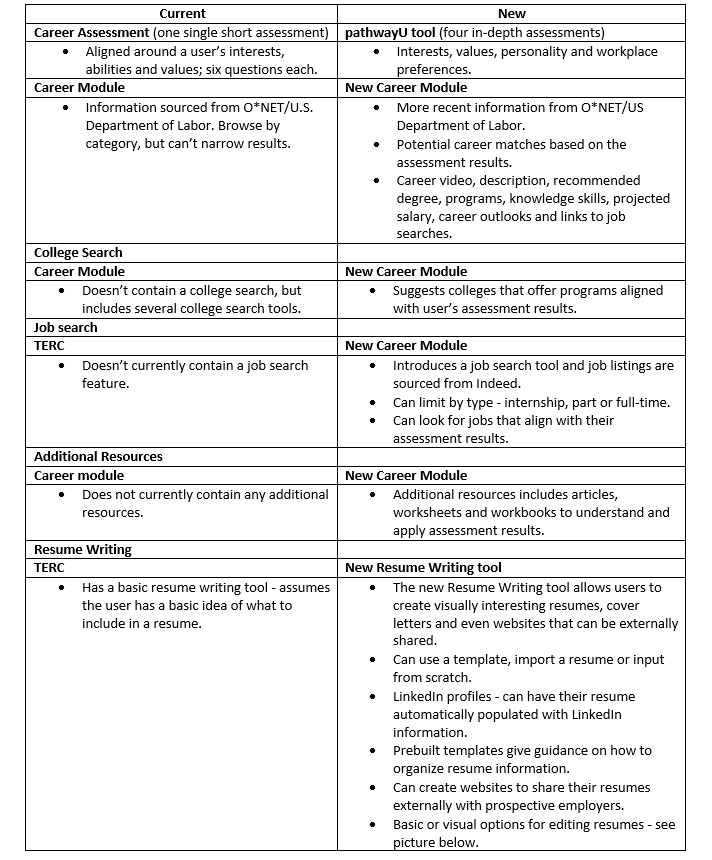
The Testing and Education Reference Center is made available via INSPIRE through a partnership between Gale and Peterson’s. Recently, great strides have been made in order to expand the career tools available within TERC. The current tools, including the resume writer and assessment in the Career Module, will remain available for at least 30 days.

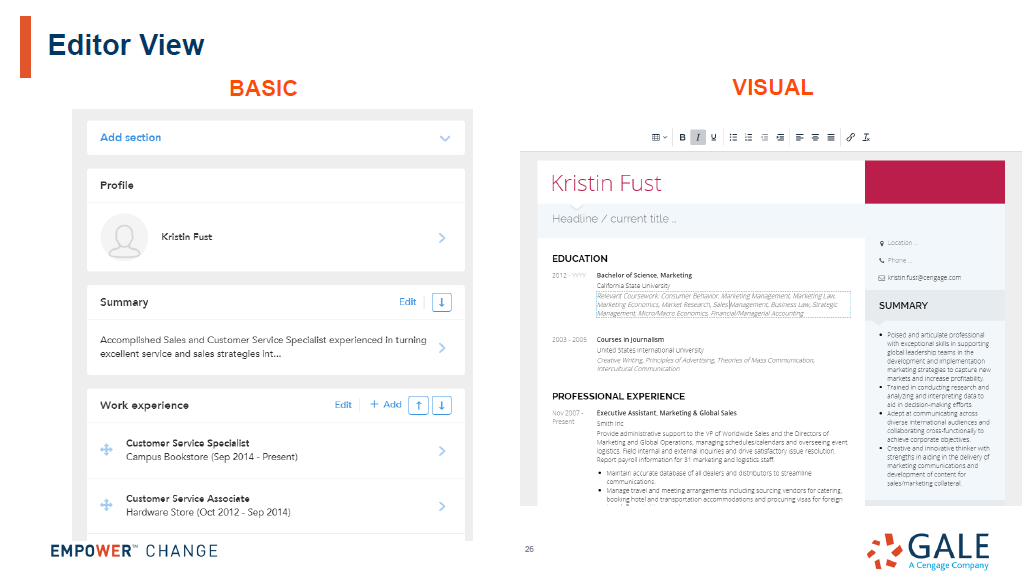
Below is a comparison between the current tools and the new tools set to debut:

This post was written by Northeast regional coordinator Paula Newcom, Professional Development Office.

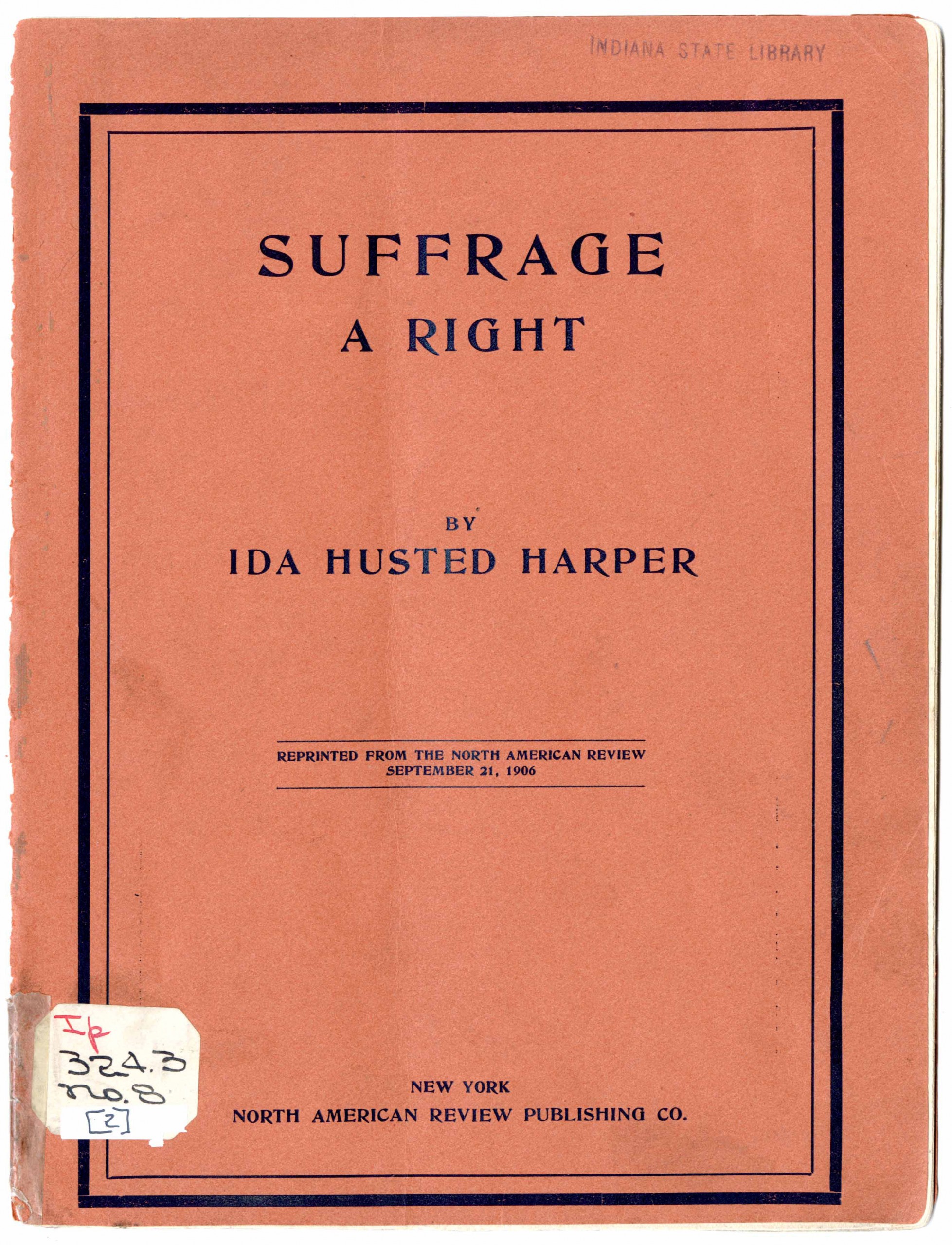
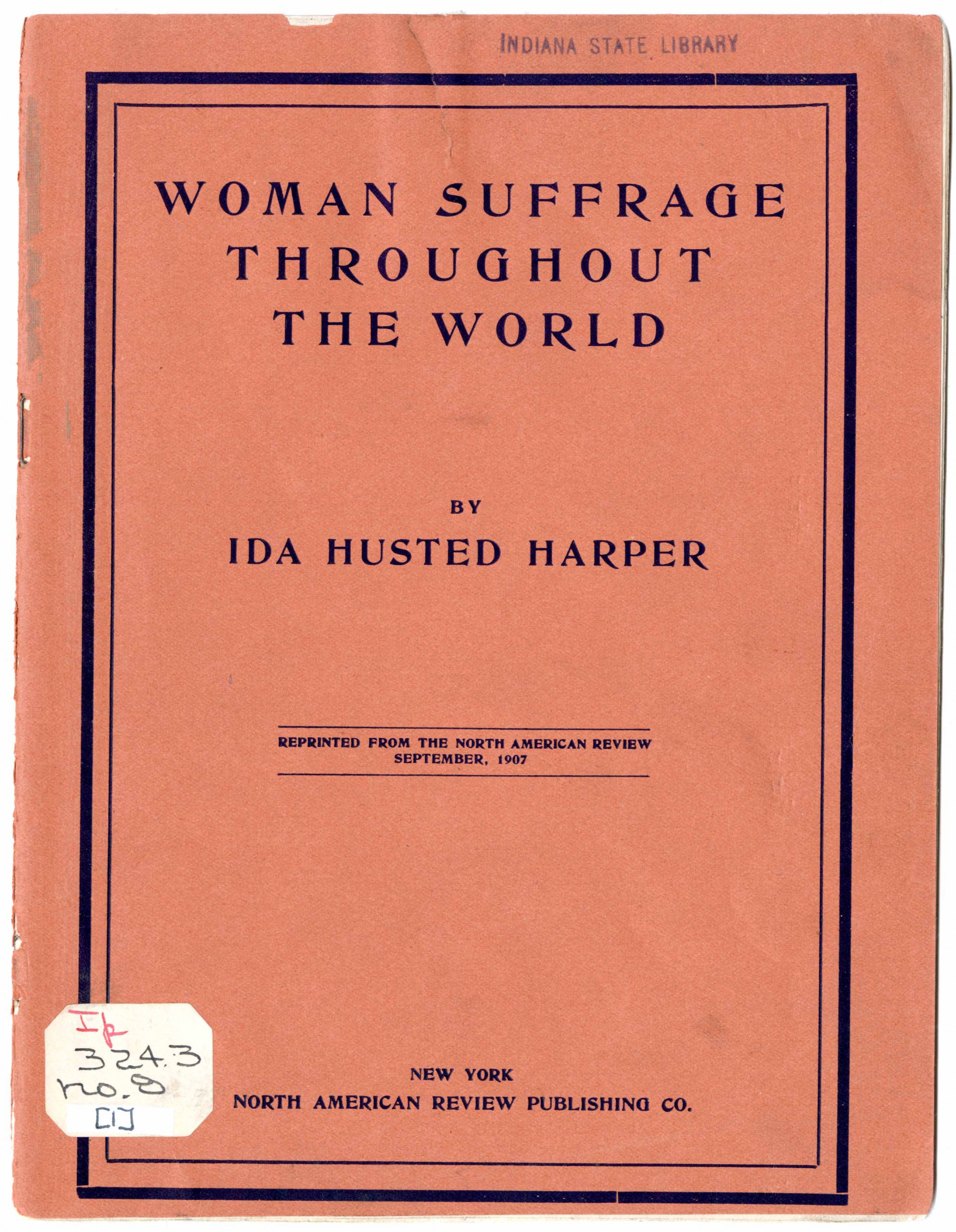
Suffrage materials in the Indiana Digital Collections

“We are convinced that the time has arrived when the welfare of the nation would be most effectually conserved by conferring upon women the privilege of voting and holding political office.” – Ida Husted Harper from “Suffrage – A Right”

In conjunction with the 100-year anniversary of the passing of the 19th Amendment, the Indiana Division has digitized many of our materials about the suffrage movement of the late 19th and early 20th century.

You can find materials in the “Women in Hoosier History Digital Collection,” one of many collections at the library. Once there, you can click on “Women’s Suffrage” under “Browse these suggested topics.” The collection can be found here. Below is a sampling of some of the collection.

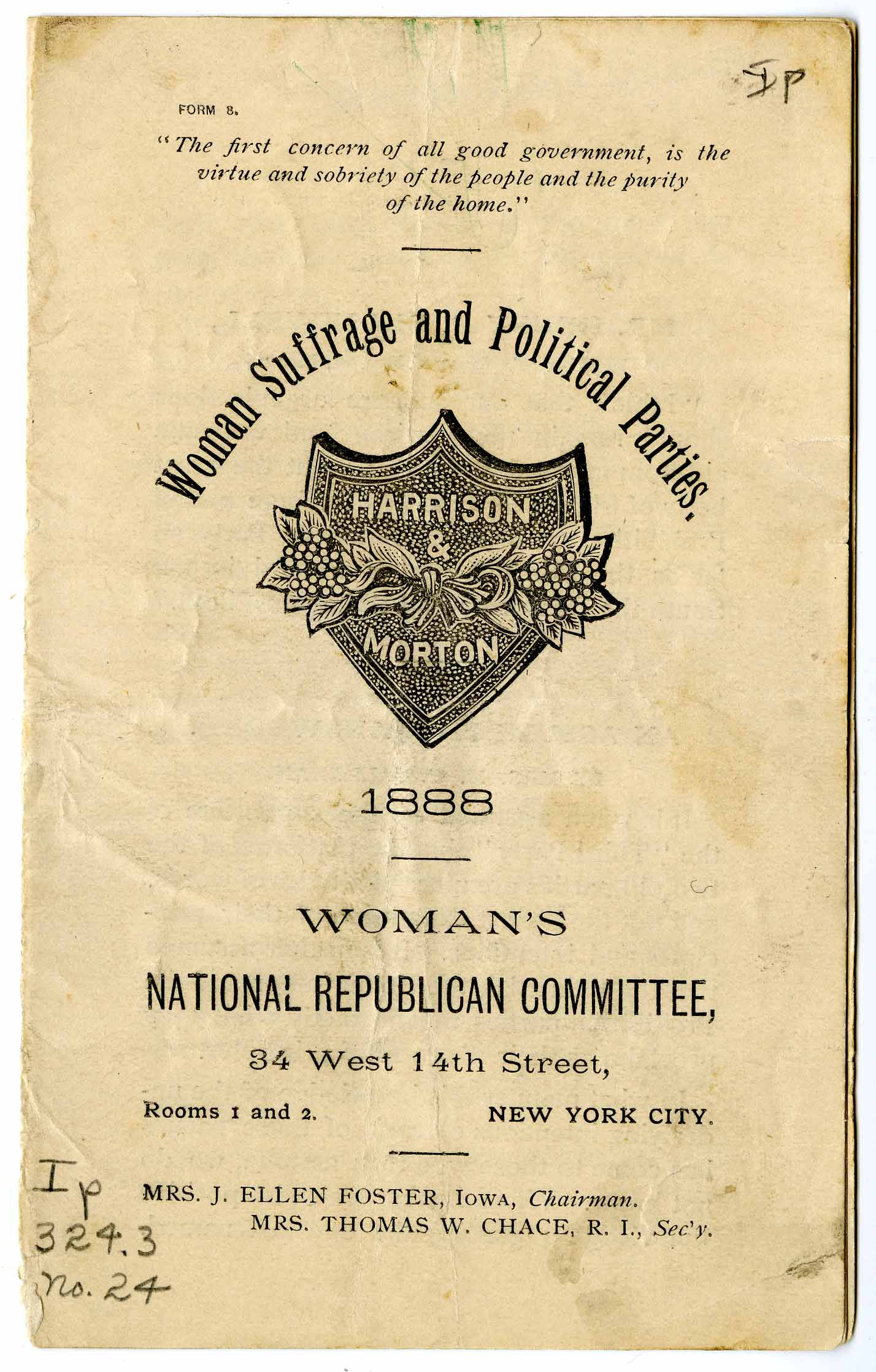
One of the earliest items is a pamphlet from 1888 during the presidency of Benjamin Harrison. It includes an article written by Susan B. Anthony.

The collection also includes two pamphlets by Ida Husted Harper. One pamphlet is about suffrage, in general, from 1906 and other about the international suffrage movement from 1907. Born in 1851, and raised in Indiana, Harper was a nationally-know writer, lecturer and suffragist. Her works include a three-volume biography of suffrage leader, Susan B. Anthony, and part of a six-volume “History of Woman Suffrage.” She also served as secretary of the Indiana chapter of the National Woman Suffrage Association.

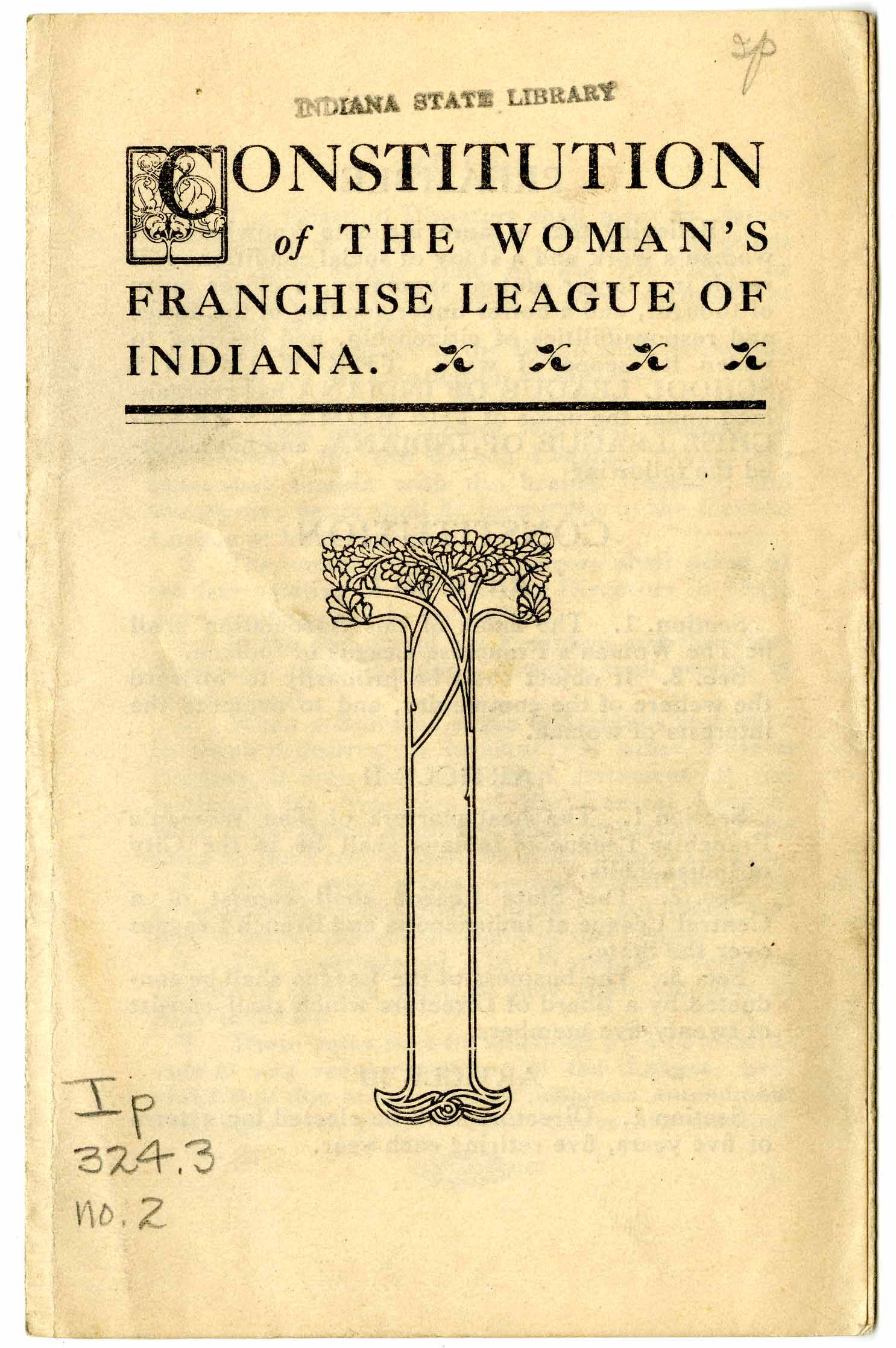
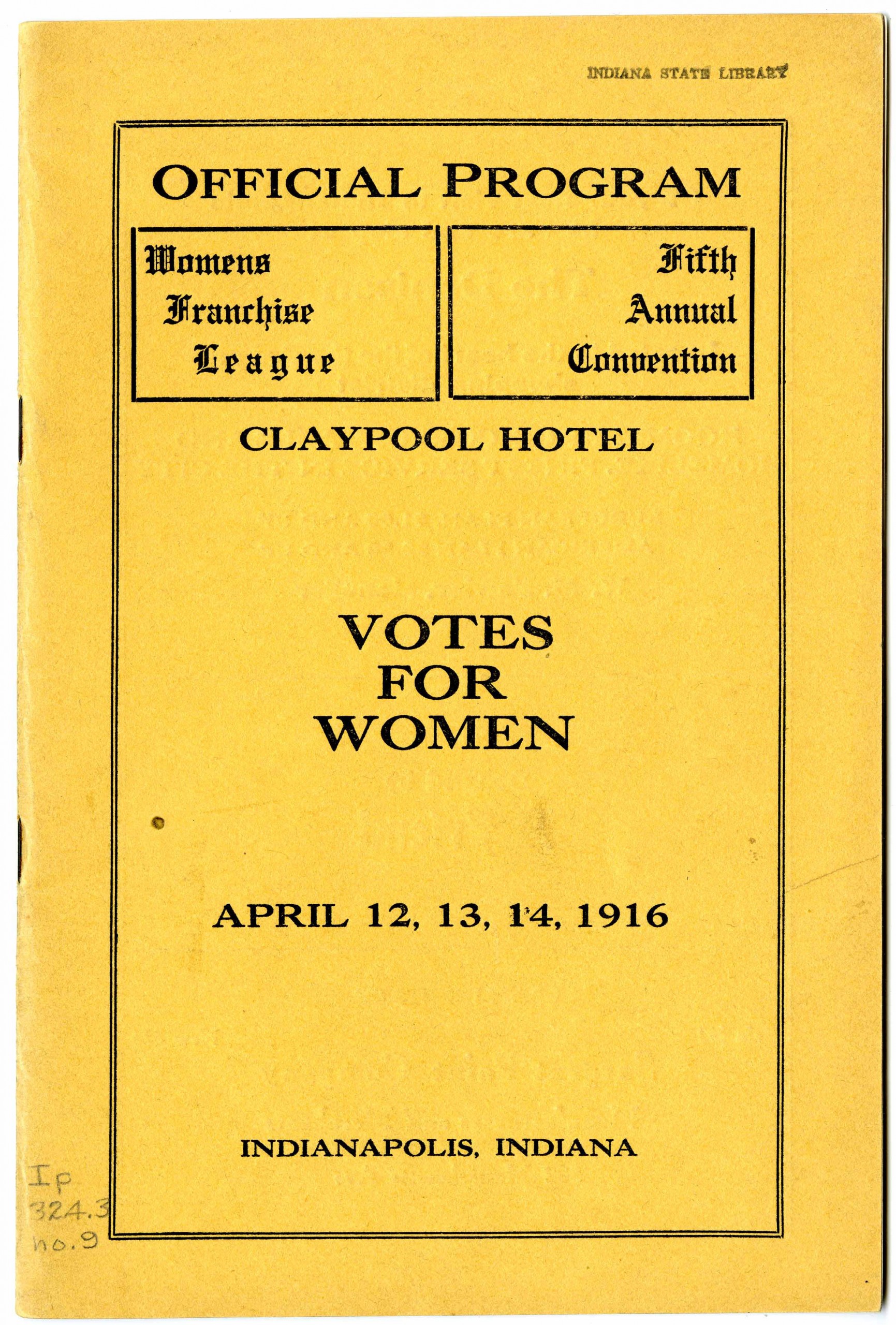
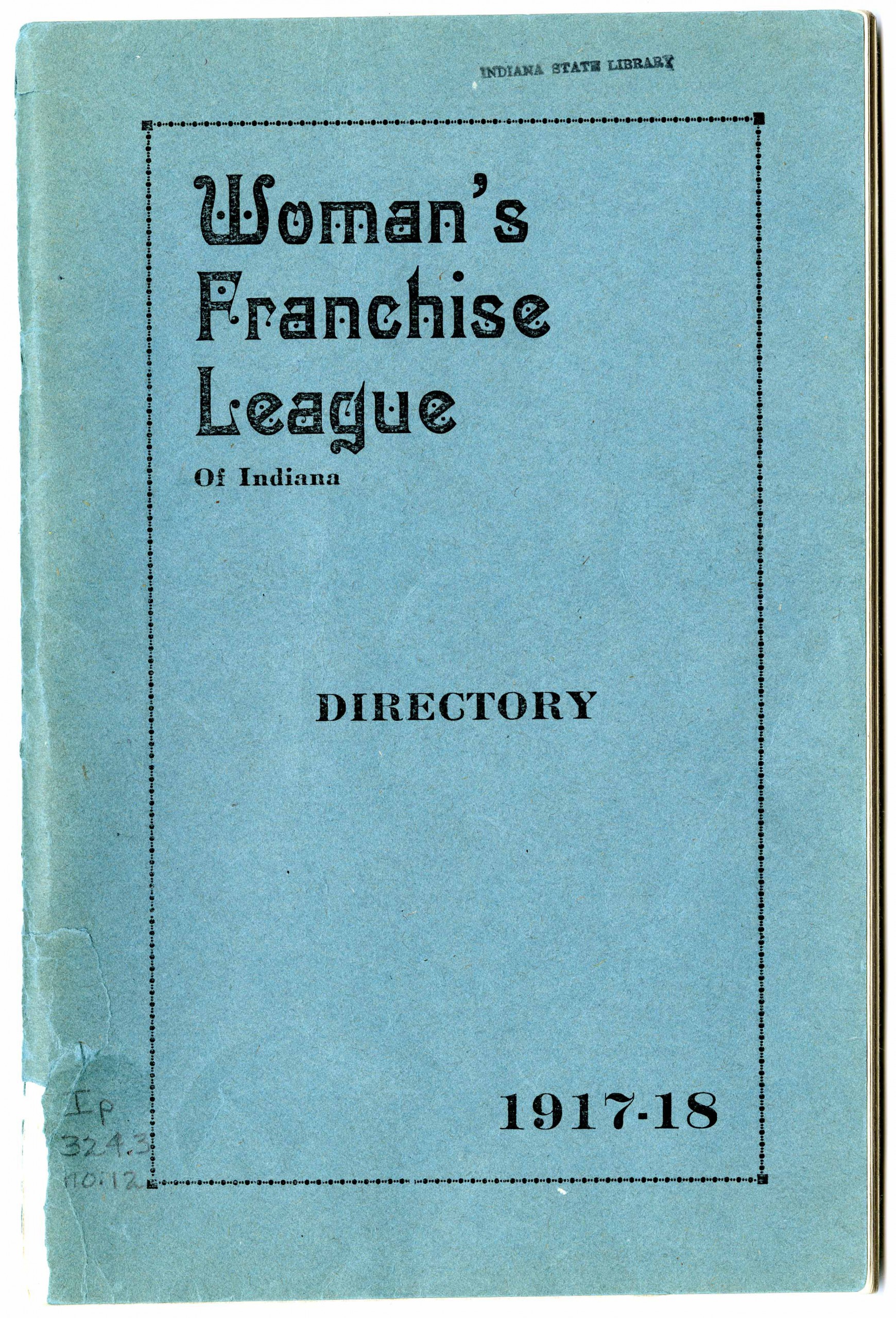
Organized in 1911, The Women’s Franchise League of Indiana began when the Indianapolis Franchise Society and Legislative Council of Indiana Women merged together. The League was associated with the National American Woman Suffrage Association and was the prominent suffrage group in the state. Their membership was 1,205 across the state. Their constitutions, programs and directories provide information about the league and its members.

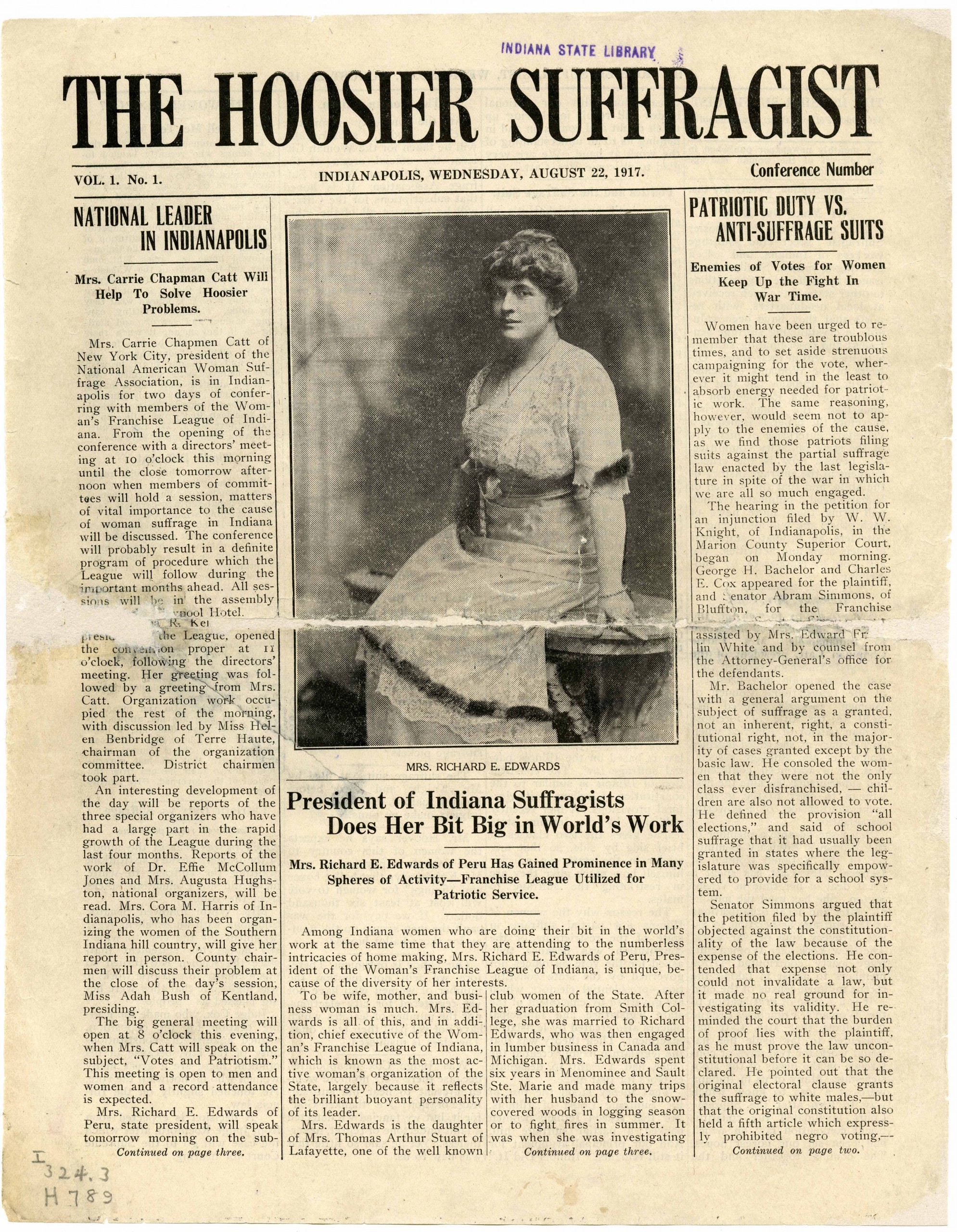
The Leagues’ publication, The Hoosier Suffragist, was “a monthly newspaper published in the interest of the woman suffrage cause in Indiana.” First published on Aug. 22, 1917, it provided information about the activities and people involved in the movement across the state.

The Women’s Franchise League of Indiana remained the prominent suffrage group until 1920, when it became the Indiana League of Women Voters, which remains in existence today. Their first congress was held April 6-8 in 1920 at the Claypool Hotel in Indianapolis. You can find their first program in the collection.

These are just some examples of what one may find in the “Women in Hoosier History Digital Collection.” Explore the collection to see what you can find.

For additional information:
Indiana Women’s Suffrage Centennial
League of Women Voters of Indiana

This post was written by Christopher Marshall, digital collections coordinator for the Indiana Division at the Indiana State Library.

Nelson and Gilly Ann Perry in antebellum Indiana

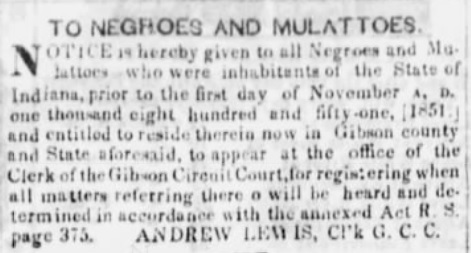
When Indiana was established as a state in 1816, its very first constitution explicitly banned slavery. Decades later, attitudes had soured. While many white Hoosiers disavowed the institution of slavery, they did not necessarily want populations of free blacks living in the state. Thus, when citizens convened for a constitutional convention in 1850, this issue was hotly debated. Many delegates, all of whom were white, expressed concern at the influx of blacks migrating to the state, particularly from southern slave states. The result was Article 13 in the 1851 Indiana Constitution which declared “No negro or mulatto shall come into or settle in the State, after the adoption of this Constitution.” A further stipulation of this exclusionary act “instructed the county clerks to notify all Negroes who were residents before November 1, 1851 to register, ordered the creation of the register of negroes and mulattoes, and empowered the clerks to subpoena witnesses and to issue certificates attesting to the registration of legal residents.”1 In addition to name, age and place of birth, these registers also listed physical descriptions of each settler. The registration certificates served as proof that the bearer was a citizen of Indiana and therefore allowed to be in the state legally, but it’s impossible to ignore that the creation of these registers served as further persecution against an already marginalized group, making them even more vulnerable in a country that was bitterly divided over the issue of slavery.

Notice alerting Gibson County citizens of the registration requirement. From the Princeton Clarion-Leader (Princeton, Indiana), May 14, 1853

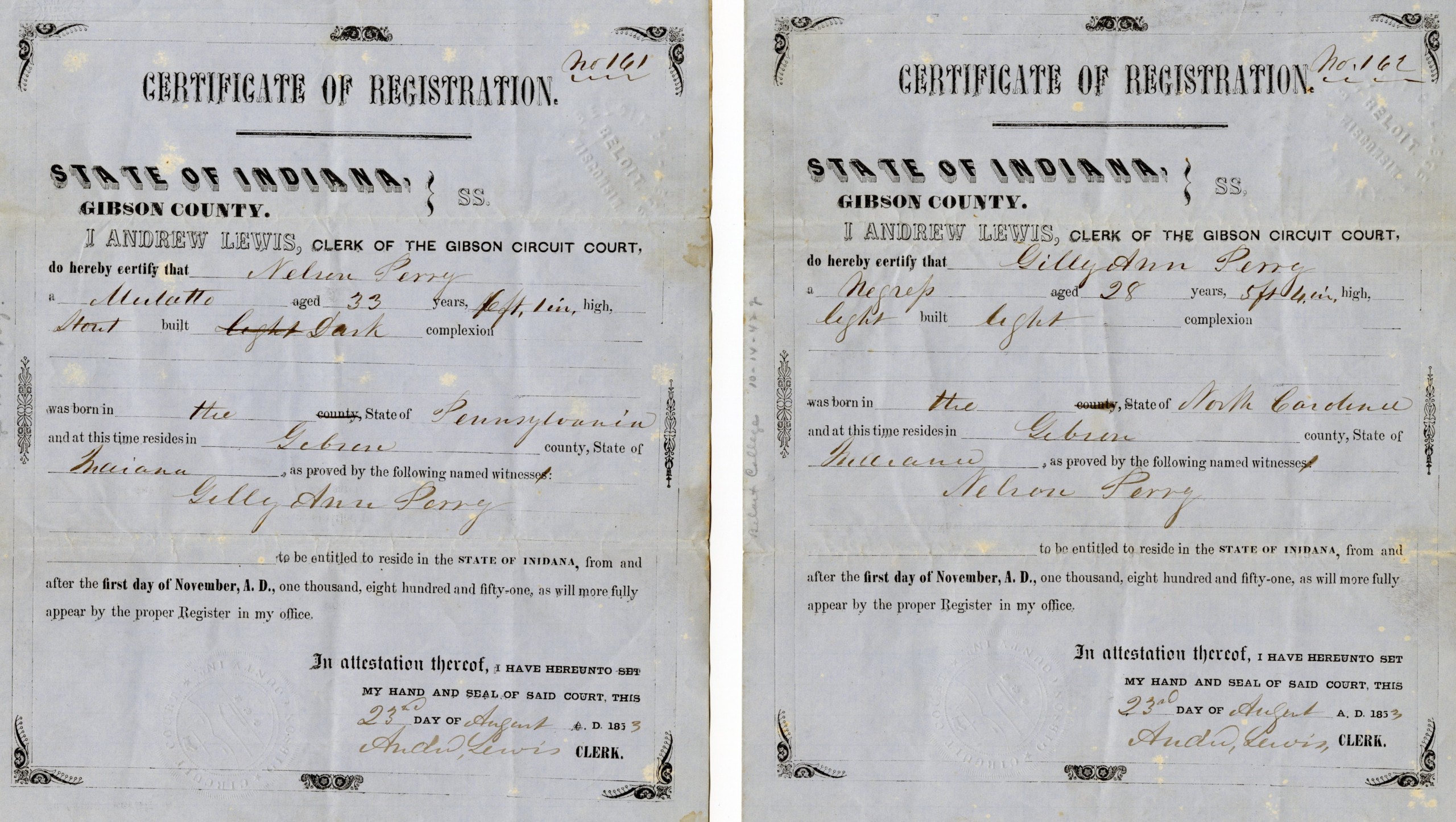
On Aug. 23, 1853, two settlers named Nelson and Gilly Ann Perry registered with Andrew Lewis, the county clerk of Gibson County, and received their official registration certificates. These documents are now in the Indiana State Library’s Rare Books and Manuscripts collection. According to the papers, Nelson was 33 years old, slightly over 6 feet tall, of stout build and dark complexion and was born in Pennsylvania. Gilly Ann was 28 years old, 5 feet 6 inches tall, of light build and light complexion. She was born in North Carolina.

Nelson and Gilly Ann Perry registration certificates, Rare Books and Manuscripts, Indiana State Library (Collection S1906)

Not much is known about Nelson and Gilly Ann, but some of their life together can be reconstructed from public records.

Years before they were required to register as free blacks, they were entered in another official Indiana registry, albeit for a more innocuous and mundane reason: On July 26, 1848 they were married in Posey County. According to the official registry, Gilly Ann’s maiden name was Eddy.

Marriage record from Familysearch.com

A couple of years later, they appear in the 1850 Census living in Mount Vernon in Posey County, Indiana. Nelson’s occupation is listed as a “cooper” which is a person who made wooden barrels and tubs. They also are living with a 50-year-old black female named C. McCalister,  but no further information could be found on her. Unfortunately, it is very probable that if she registered as a free black in Indiana, it was in Posey County and that registry is known to be missing.

Census entry from Ancestry.com

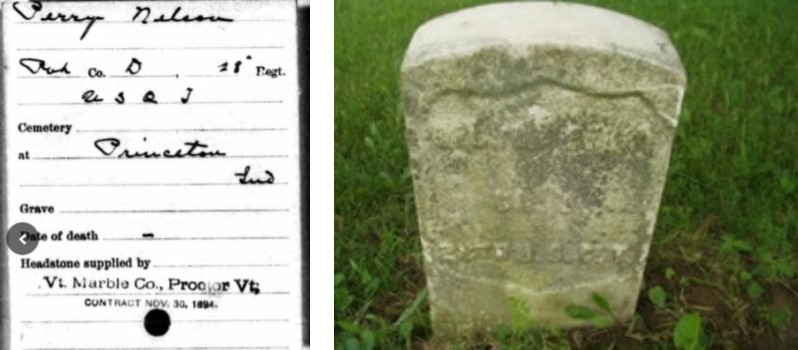
On Jan. 4, 1864, Nelson Perry enrolled in the United States 28th Colored Infantry Regiment, Company D. By this stage of his life, Perry was in his 40s but still willing to serve for the Union cause. A note on his military record indicated he had been “absent sick in hospital at New Orleans, LA since 7/15/65.” He was officially discharged on Nov. 8, 1865.

Later, Nelson’s name shows up in miscellaneous military paperwork including a list of Union Civil War veterans who were given official government-provided headstones.

Headstone application from Ancestry.com. Photograph of Nelson Perry’s tombstone from findagrave.com


No date can be found for his death. Presumably, he died prior to 1894 since that is the date on the headstone application. He is buried in Princeton, Indiana in Gibson County.

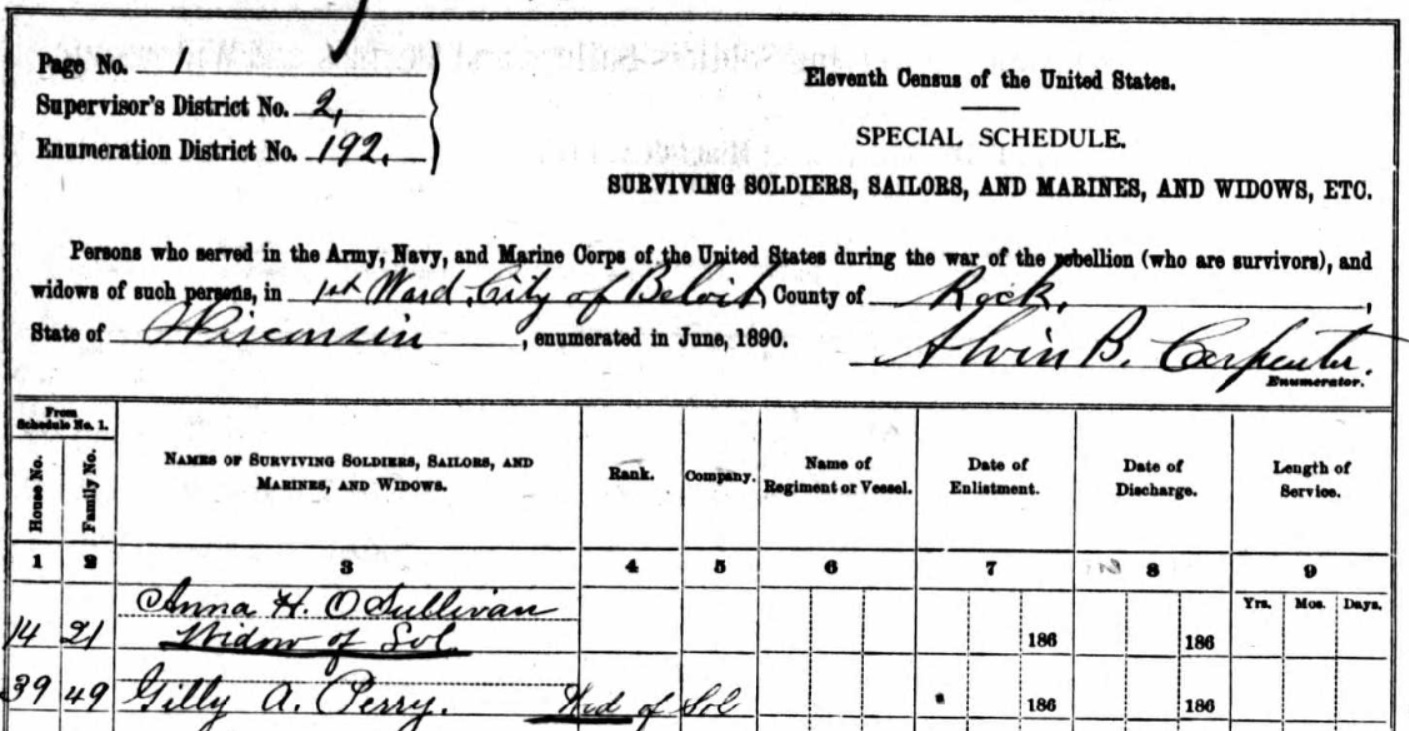
Gilly Ann is largely unaccounted for during the Civil War years and there is no evidence that she and Nelson had children. She shows up again in public records in the 1875 Wisconsin State Census, living in Beloit, Rock County near the Illinois border. She also appears in the 1890 United States Census of soldiers and widows, again in Beloit.

Image from ancestry.com

Interestingly, the Indiana State Library was given both Nelson and Gilly Ann’s Indiana registration papers from Beloit College where, presumably, Gilly Ann had donated them for posterity.

Official documents provide merely a rough outline of the lives of Nelson and Gilly Ann. What we know about Indiana history during the antebellum era can help flesh out their story even if, ultimately, any conclusions we draw are pure conjecture. For example, we know from her registration papers that Gilly Ann was born in North Carolina. Many free blacks and former slaves migrated to Indiana from North Carolina with assistance of North Carolina’s Quaker community. Quaker led caravans – sometimes made up of hundreds of people – made the long trek west. Migrating in such a manner was a safer alternative to escaping through other means, such as the Underground Railroad, because travelers were under the protection of their Quaker traveling companions. When the caravans reached Indiana, the free blacks would either continue to head further north to Michigan or Canada or they settled in Indiana, often within or near Quaker communities. It is quite possible that Gilly Ann was brought to Indiana from North Carolina in such a caravan.

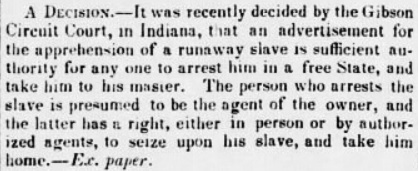
In 1848 and 1850 we know that both Nelson and Gilly Ann were in Posey County. Based on the 1850 census, we know they were living in Mount Vernon, Indiana, a town situated directly on the Ohio River with Kentucky – a slave state – nearby on the other side of the river. In September of that year, the United States Congress passed the Fugitive Slave Act of 1850 which further compromised the rights of free blacks in northern states and made them more susceptible to kidnapping and being sold off to southern slave owners, even if they had never been enslaved before in their life. Being situated on the Ohio River, Nelson and Gilly Ann’s home was located in an especially perilous place as bounty hunters constantly roamed the area surrounding the river looking for escaped slaves or others who they could bring in for a financial reward. Bounty hunters could abduct people suspected of being runaway slaves with little or no evidence.

Clipping from Indiana State Sentinel (Indianapolis, Ind.), Jan. 25, 1848

Living so close to the Ohio River, it is entirely possible that the Perrys were involved in the Underground Railroad to some degree and like many other free blacks were instrumental in assisting others on their journey north. However, in 1853 the couple had moved a bit north to Gibson County. Perhaps they wanted to get farther away from the Kentucky border. Or perhaps they made the move because Gibson County was home to a larger number of free blacks and had several established black rural settlements. According to the 1850 census, Posey County’s black population was 98 while Gibson County’s was 217, almost double the size. Whatever the reason, it seems to have been a permanent relocation since we do know that Nelson Perry eventually ended up being buried near Princeton, a town located in Gibson County.

While all this is merely speculation, contextualizing what little is known about Nelson and Gilly Ann from public records within the broader narrative of general U.S. history allows for a richer and more complete story to emerge. That these registration papers were saved for decades, journeyed from Indiana to Wisconsin and were left in the care of a local college only to make their way back to Indiana is remarkable and a testament that Nelson and Gilly Ann must have wished their story to be remembered.

The Indiana State Library has numerous resources documenting this period of Indiana history. Some used for this blog post are:

Brown, Maxine F. “The role of free blacks in Indiana’s Underground Railroad” (2001). ISLI 973.7115 B879r
Hudson, J. Blaine. “Fugitive slaves and the Underground Railroad in the Kentucky borderland” (2002). ISLI 973.7115 H885f
LaRoche, Cheryl Janifer. “Free black communities and the Underground Railroad” (2014). ISLI 973.7115 L326f
1. Robbins, Coy D. Indiana negro registers, 1852-1865 (1994). ISLR 977.2 I385nr
Thornbrough, Emma Lou. “The negro in Indiana : a study of a minority” (1957). ISLI 325.26 T497n
“Underground Railroad : the invisible road to freedom through Indiana” (2001). ISLI 973.7115 U55

Online resources
Indiana Dept. of Natural Resources. Underground Railroad
Indiana Historical Society: Early black settlements

This blog post was written by Jocelyn Lewis, Catalog Division supervisor, Indiana State Library. For more information, contact the Indiana State Library at 317-232-3678 or “Ask-A-Librarian.”

Indiana Library Leadership Academy member project recaps

My first year as Professional Development Office supervisor at the Indiana State Library started with me taking over the planning of the 2018-19 Indiana Library Leadership Academy. This past week I sent out the applications for the 2020-21 cohort. With the next academy on the horizon, I would like to highlight some 2018-19 INLLA cohort members’ projects. Below, some of the 2018-19 INLLA members describe their projects.

Jennifer Taylor, Hagerstown Library
“[My goal] was increasing the number of teen workers at the library, and we’ve hired two more teenagers to work in the library. I’ve increased my involvement at our local high school to get more teen programs occurring in the local high school. I also capitalized on International Games Week to increase the game programs in the library at the high school, which met two times there that week. I had 50-54 high school students at each of those programs. Since then, I have been at the high school once a week, and still kept 48-50 students at each game session. There was also a feature about the gaming programs that I have done, including the junior high school program, in a local paper that was then featured in the Indiana Library Federation newsletter in October about “Great Things in Libraries.”

Because of her involvement with the area schools, Jennifer’s library saw a 60% increase in participation in their Summer Reading Program. She is slated to do three webinars related to gaming for the Indiana State Library this year.

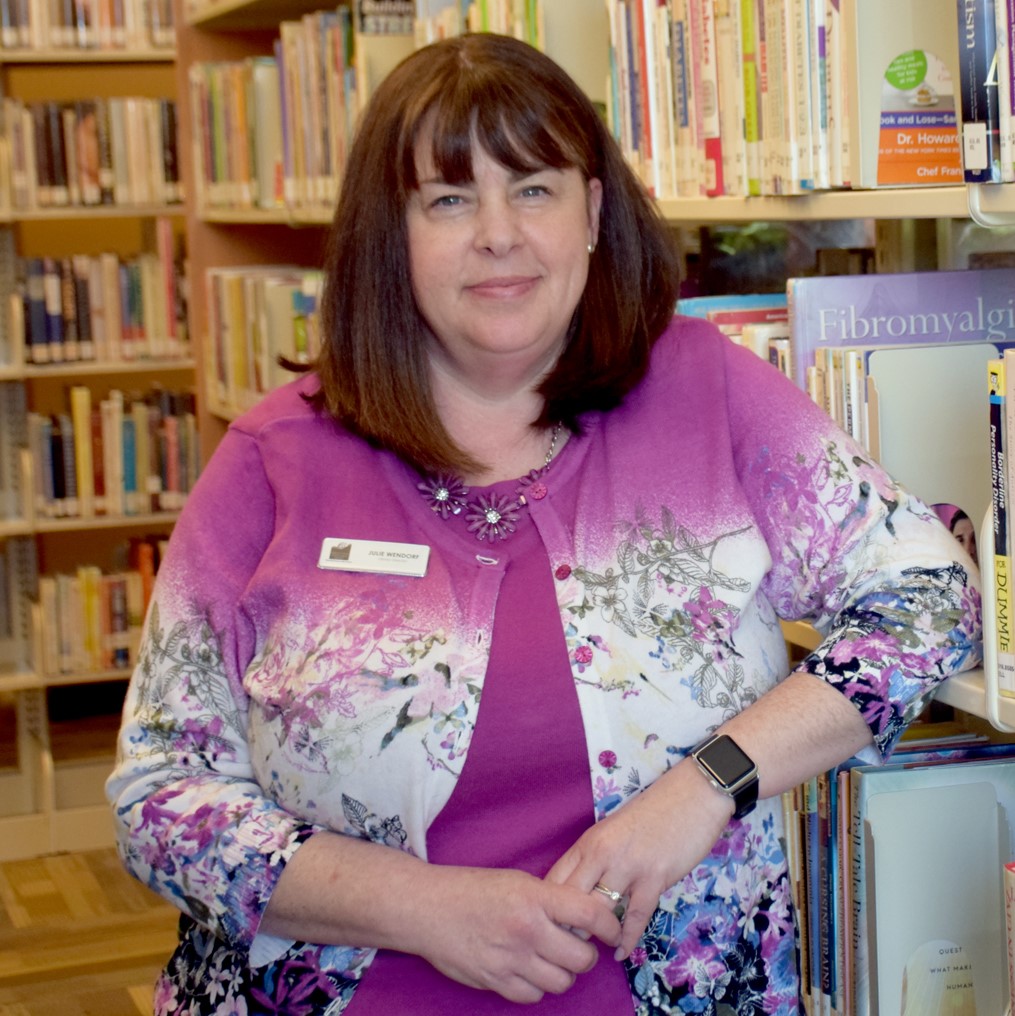
Julie Wendorf, Crown Point Community Library
“I wrote and got a grant to fund the TumbleBooks database for the next two years. The use at the schools started in November 2018. I worked with the school’s central office to promote the resource and coordinate adding the database to the school’s integrated one-on-one instruction and content management system. I am thrilled to share that that the use of the database went from 8 views in September, 86 in October and to almost 8,800 views in November. This success will be great as I move forward in the push to get digital library cards for all students in the school system. We will push out staff outreach visits to all the elementary schools during lunch time to issue library cards to all teachers in the district and further share library resources with individual teachers. The successful use of the database will help show the need for more partnerships between school and library. We’re looking at doing targeted visits to the high school to share about INSPIRE when we get those digital cards in place. It would be great to share other databases, too. I’m excited to go to the auto repair class and share Chilton’s. The library also created a bookmark for sensitive teen issues and had the library designated as a Safe Place.”

Melissa Hunt, Morrisson-Reeves Library
“My senior library card [project] is going well. I am established at three senior living facilities. The card gives seniors a slightly longer checkout. Staff at the facilities are working with this project and are trained to help the residents place holds so that they are getting items ready ahead of time and between myself and the staff we are getting the books to the members. One facility has declined to participate in the program, but we were able to take some weeded materials and our Friend’s group is allowing me to take some materials from their donations to that center as well. Because of this project, the senior center asked me to give a presentation about Morrison-Reeves Library and its resources. They would also like to set a book club or library help time. We are working out those details. Maybe I will train some senior center volunteers to run the club and a few staff at Morrison-Reeve Library are willing to go and help at a scheduled time about every 4 to 6 weeks at the center. I am also running two book clubs at two of the senior facilities. Going to the senior center sparked a youth services staff member to visit preschools and elementary schools to promote library cards and do story times.”

Leslie Sutherlin, South Dearborn School District
“My schools, the middle school and high school in South Dearborn, are hosting author Alan Gratz. I’ve created a packet of resources for teachers on Alan. We are also having a few guest speakers and possibly a panel. I have been in contact with an immigration lawyer as one of the guest speakers. We are also having someone from the Holocaust and Humanities Center in Cincinnati speak. When Alan comes, we may have him present in the evening at our local public library.”

Becca Neel, David L. Rice Library, University of Southern Indiana
“The overall goal of my project was to expand online library instruction and research support for students and instructors in Indiana high schools offering dual credit through USI’s College Achievement Program. To accomplish this goal, I’ve been working closely with our infinitely helpful and supportive CAP administrative team on campus to collaborate on training, communication and promotional efforts. This partnership has afforded me a myriad of opportunities to exchange ideas and to share resources and services with a diverse group high school CAP instructors via LibGuides and Zoom instruction sessions. A list of CAP LibGuides resulting from recent instructor collaborations can be found here.

“More recently, this project has connected me with some incredibly innovative and energetic media specialists from CAP partner high schools who have been instrumental in providing me with both a context for approaching information literacy in a non-university environment and an audience willing to listen to incessant gushing over INSPIRE database content and navigation.

“As the result of these various partnerships, and with the support and supreme event-planning expertise of the USI Rice Library’s head of public services, library support for the CAP community will continue its expansion through a day-long Linking Information Literacy Across CAP workshop aimed at bringing together USI librarians, media specialists and public librarians connected with the CAP high schools.

“This workshop is intended to foster long-term network of collaboration among librarians and media specialists, and will feature info-sharing and brainstorming sessions, as well as resource and technology training to provide school librarians with editor privileges for school-specific LibGuides.

Carrie Vrabel, Allen County Public Library
“My project became the creation and promotion of a free, web-based resume generator especially designed for patrons with beginner-level computer skills.

“This resume generator creates a formatted, printable and saveable resume. There are instructions for printing at the top of the page. Many of the fields auto-capitalize for patrons with beginner-level computer skills and there are examples of wording that can be used in the qualifications and skills fields.

“I sent the link to ALA’s ThinkTank on Facebook and received overwhelmingly positive feedback. I also presented this new resource at the ILF Regional Conference in Mishawaka on Monday, April 22, 2019. To my knowledge, Resume Generator is the only free web-based resume generator on the internet, so I hope to get the word out to as many librarians as possible!”

Jenna Anderson, Kendallville Public Library
“Following an inspirational conference session on a STEM program for teens in 2017, as the Kendallville Public Library Marketing specialist I thought, ‘What if I took some of these ideas, added more topics, put the program online and expanded it to everyone?’

“In June 2018, the Kendallville Public Library unveiled Design Your Climb, an online, points-based system for learning and fun. At the time, the challenges included library skills, makerspace experiences, robot programming and other library-related activities. It generated some excitement in the community, especially because participants could win prizes as they earned points.

“Once again, that ‘what if’ question took over. What if the library expanded Design Your Climb so people could not only experience the library, but experience the community? Through the Indiana Library Leadership Academy, I learned valuable leadership skills and developed a plan of attack for involving the community in Design Your Climb.

“I approached local organizations and nonprofits, offering them the benefits of the library’s exposure at no cost to them. In exchange for working with the library to develop a challenge track specifically for them and promoting it through their own marketing channels, the library would support the challenge on its online system, promote the challenges as well and award prizes. Many recognized a win-win when they saw it, and took the library up on the offer. To date, three organizations have four on-going challenges among them, while several more are developing their challenges. The number of Design Your Climb participants continues to grow, while the awareness of the services in the community increases, as well.

“Design Your Climb is a partnership between the Kendallville Public Library and the East Noble School Corporation. KPL handles the Personal Growth portion of the initiative, while East Noble is unveiling the Educational Growth portion of Design Your Climb to its second grade students. Design Your Climb Personal Growth can be found here.”

Jenna was so inspired by INLLA, and specifically speaker Cathy Hakala-Ausperk, that she says it literally changed her life. Her approach to her job has expanded, she has pursued additional leadership training and is now moving herself and her library in new and exciting directions. She was also recently promoted to support services manager.

Charles Rude, Kewanna-Union Township Public Library
“I am attempting to digitize a collection of my home town newspapers. I have the library’s support with some budget funds, legal ownership of the papers for the library and a loose commitment of funds from the community foundation. At this point, I am still hoping to get other local organizations on board and expand my scope. I am in discussions with the historical society and my library neighbors and towns. I am asking them for contributions or whatever they can do to support the project and they seem very positive. I still feel strongly that we need to preserve our history for future generations so I will be working with these organizations to get the ball rolling.”

Katie Lehman, Muncie Public Library
“My educational resource boxes are being built by a local Eagle Scout and will be installed at our south side branch and at a partnering location. Inside the boxes there will be educational tools and supplies that anyone can take and utilize. This will include things like crayons, glue sticks and different educational activities assembled by Ready Readers staff. I am looking at partnering with either the YWCA or YMCA as the second location for a box.

“Many of the children in my program talk about not having items such as crayons, markers, glue, dice, etc. at home. While many locations give these things out at the beginning of the school year, the supplies often must stay at school. Even when they do go home, they are used up quickly, lost or thrown out in a quick move.

“While it is not specific to my INLLA project, I did want to share that since INLLA, I have secured two grants for Muncie Public Library’s Ready Readers Program. One through Psi Iota XI to update the furniture in the room to make sessions more comfortable and one through Delta Kappa Gamma for teaching supplies to use with students in sessions.

“I feel that I gained a lot out of my INLLA experience. One thing that really stuck with me was a response from one of the panel members who said, ‘Keep your head down and do the work. I’ve kept that mantra and it’s paid off! I was recently promoted to director of academic enrichment and now supervise 10 staff and more than 85 kids.”

If you would like to apply to be a part of the 2020-21 INLLA Cohort, click here for the application. The application is due Friday, Feb. 28. If you have any questions, please contact Kara Cleveland at 317-232-3718 or via email.

This blog post was written by Kara Cleveland, Professional Development Office supervisor at the Indiana State Library.

2020 LSTA grants for libraries

Once again, the Indiana State Library will be the recipient of over $3 million dollars in Library Services and Technology Act grant funding through the Grants to State Library Agencies program of the Institute of Museum and Library Services. In IMLS’s latest budget, the federally-funded Institute received $6.2 million more for the LSTA program than the previous year, the largest increase in 12 years. These funds will be divided among all states and US territories based on population – a great reason to participate in the 2020 census.

To see how Indiana used grant funds received during the 2018-19 grant year, check out the following video created by Angela Fox, public library and LSTA consultant:

While a majority of the funds received for 2020-21 will be used to continue support for statewide services like INSPIRE.in.gov, Evergreen Indiana, SRCS and the Talking Book and Braille Library, a portion of the money will be available for 2020 LSTA grants for libraries. Two types of grants will be offered: A technology grant of up to $8,000 and a digitization grant up to $15,000. These grants are available to most libraries, including public, academic, institutional, special and school libraries.

Proposed projects should have demonstrable benefits to the library’s users and community members as a result of new products and services offered through the grant project. Library staff considering applying for a grant should reach out to LSTA consultant Angela Fox. Angela is available to answer questions about proposed projects and even provide a cursory review of applications before they are submitted.

All grant applications will be reviewed by a panel of State Library staff and external reviewers, which will be assembled from public, school and academic libraries across Indiana. Grant applications are due Mar. 20 and award announcements should be made by May 2020.

This post was written by Jen Clifton, Library Development Office, Indiana State Library.

2020 Census outreach

The U.S. Census Bureau held a kick-off for the 2020 Census ad campaign Tuesday, Jan. 14. For each decennial census, the Census Bureau hires an agency to conduct research and distribute messaging to encourage participation in the U.S. Census. The 2020 campaign, according to a Jan. 14 press release, “employs multi-language ads, partnerships and trusted voices.” The Census Bureau’s tagline, revealed in 2019 is “Shape your Future. Start here.” Examples of the new ads are available here. Census partners are encouraged to have local organizations use the national campaign materials in news media, social media and other outlets.

Efforts to publicize the census have been underway in Indiana for the past several years. The Philanthropy Alliance of Indiana made it a priority to connect its members with census resources early on in the state’s efforts. The Indiana State Library’s State Data Center has worked closely with the Indiana Business Research Center and the Indiana Department of Administration to coordinate efforts at the state level. The IBRC maintains the Census in Indiana website, a “for Hoosiers by Hoosiers” resource for digital and print materials promoting the 2020 census.

New on the site is a Promotional Tool Kit section which includes images and widgets for your websites. For librarians, there is a 2020 Census Toolkit containing important dates in the census, talking points and FAQs for Indiana libraries, an online resource list and ideas for displays and programs. The Census Bureau’s Facebook and Twitter pages contain daily updates about 2020 Census promotion. The State Data Center’s Facebook and Twitter pages post national, state and local updates about the 2020 census.

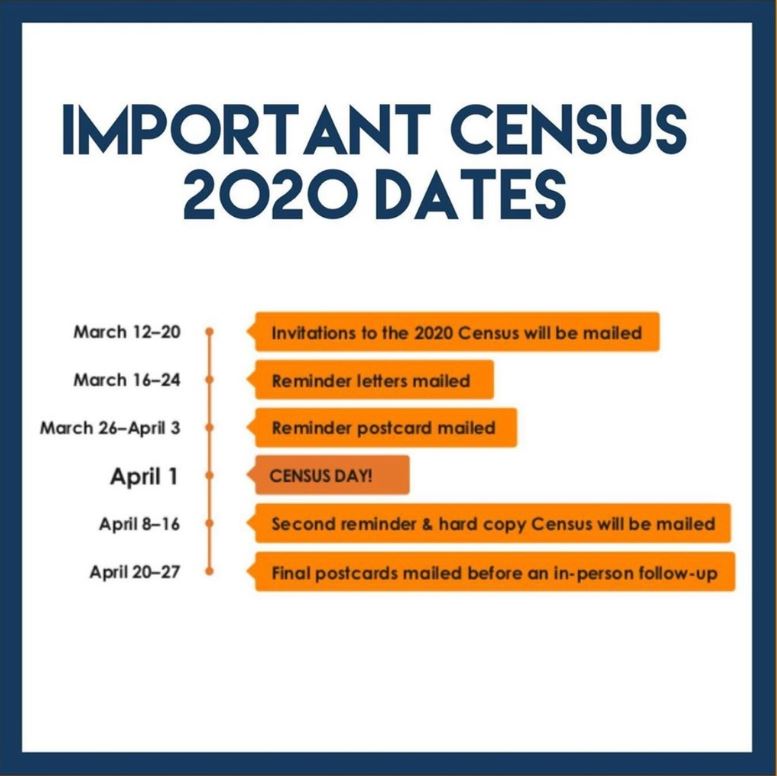
In mid-March, most U.S. households will receive an invitation to fill out the census online. A series of mailings will follow until each household completes the census online, by paper form or via telephone.

Please contact the library’s State Data Center for questions about the 2020 Census.

This blog post by Katie Springer, reference librarian. For more information, contact the Reference and Government Services Division at 317-232-3678 or submit an Ask-A-Librarian request.

New year; new genealogical you

The start of a new year generally means new goals, usually dealing with health goals or organizing one’s life in one way or another. If you’ve been thinking about how you could apply that to your genealogical research or want to try new things here are some suggestions for genealogy resolutions for 2020.

Photograph of Olive, Iris, Zula, Bernard and Eunice Chambers, children of Fred H. and Gladys (Sinnett) Chambers from the Indiana State Library’s digital collections.

Back up your data
If you’ve been putting off backing up your genealogy research for “later,” 2020 is a good year to tackle backing up your research. Losing genealogy data due to a hard drive crash or from an unexpected event like a house fire can be devastating. Whether you decide to back up your information in the cloud or with a hard drive keeping copies of your research in different places will help eliminate the chance of massive loss of one’s research.

Visit an institution that you have not been to before
As most researchers realize after doing genealogy research for any amount of time, not everything is available on the internet. Many materials can only be accessed in a library, archives or other local organizations since they are often under copyright and cannot be digitized. Often, regional or local institutions may have materials relating to local families in the area that larger institutions don’t have in their collections. Taking the time to visit area libraries or historical societies where your ancestors lived may yield new information or new clues if you’ve hit a brick wall.

Attend a genealogy conference
Attending a conference is a great way to pick up tips and new research techniques. Many regional and national conferences offer a wide variety of topics and presenters for a fairly reasonable price. Or perhaps attend a conference with a more narrow focus, generally on one specific topic or field of genealogy.

Some larger conferences offer a virtual pass, where, for a reduced rate, you can watch a selection of talks from the comfort of your home. The National Archives has a yearly Virtual Genealogy Fair that is free, the videos are available on YouTube and you can download the handouts to your computer.

Take a DNA test
Genetic genealogy has become a popular area of research. DNA kits from Ancestry and 23andMe are popular gifts for people wanting to learn more about their ethnicity or to connect with family members. The three big companies are the aforementioned Ancestry DNA and 23andMe, along with MyHeritage. For more information about the field of genetic genealogy check out the International Society of Genetic Genealogy.

Prioritize your resolutions
After you’ve created a list of things you would like to accomplish go through and identify the ones you want to tackle first. Perhaps you weren’t able to get through everything you wanted to last year, or you have one goal you really want finish, like scanning and organizing your family photos and other genealogical materials. Create realistic goals and timelines for completing each task, and have a plan in place on how you are going to accomplish everything you want to finish in the coming year.

Blog written by Sarah Pfundstein, genealogy librarian, Indiana State Library. For more information, contact the Indiana State Library at 317-232-3689 or “Ask-A-Librarian.”

The Samara House in West Lafayette, Indiana

There are several buildings designed by famous architect Frank Lloyd Wright in the state of Indiana. Possibly the best known example of a private home design is the John E. Christian home, called Samara, in West Lafayette, completed in 1956. Samara is named for the winged seeds that come from pine cones. I found a book about the Wright-designed Samara in the Indiana State Library’s Indiana Division collection titled “Frank Lloyd Wright’s Samara Winged Seeds of Indiana” by Wallace J. Rogers (ISLI 720 R731f). The forward to the book is written by John E. Christian, PhD, the home owner who worked with Wright in designing and building Samara. Christian was a professor at Purdue University, and for that reason wanted the house to be built in West Lafayette near the Purdue campus. He intended to hold gatherings of students and professors there, as well as live there with his family.

After John, his wife Kay and daughter Linda visited Taliesin, Wright’s summer home and studio, Kay decided that she wanted Wright to design a home especially for their family’s needs. However, they could not afford a house at that time. Luckily for John and Kay Christian, once Wright found out that they had more than an acre of property on which to build a house, he agreed to design their home.

Wright had begun advertising his Usonian home plans that began at $5,000. Samara was meant to be one of Wright’s Usonian designs, during the post-World War II era.  Usonian design was an idea Wright had for functional but stylish homes for middle-class customers. Several entire communities around the country were designed around the Usonian ideal.

Working with Wright was not for the faint of heart. Wright reportedly had a difficult personality and liked to dictate what types of furniture, down to the lampshades, should be included in the homes he designed. In the Rogers book, there is a glossary of furniture designed especially for Samara in the back of the book. John and Kay Christian were committed to following Wright’s directives as far as décor.

In Roger’s book, the details of the designing and building process, along with pictures of the plans and furniture are abundant. Unfortunately, though the cover is in full color, the pictures in the book are all in black and white. Samara has a website which indicates that it is in the process of being updated. However, the photographs of the house are spectacular. The furniture is colorful and also looks useful as well as comfortable. There are soaring windows and intricate woodwork for which Wright’s designs are famous. Samara is open for tours during parts of the year, even though it is a private residence.  The website indicates that the house is open for tours April through November, although by appointment.

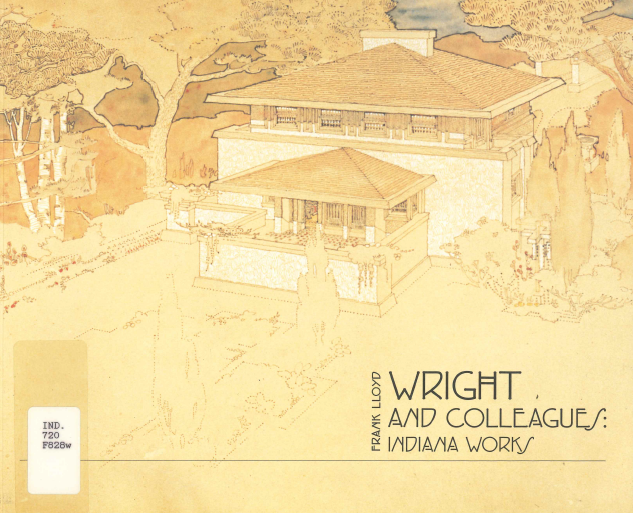
If you are interested in other Wright-designed structures in Indiana, you may want to look at “Frank Lloyd Wright and Colleagues: Indiana Works.” The picture above is a program from the event organized by Barbara Stodola that was held July through September in 1999. The exhibition was held at the John G. Blank Center for the Arts in Michigan City.

This blog post was written by Leigh Anne Johnson, Indiana Division newspaper librarian, Indiana State Library. For more information, contact the Indiana Division at 317-232-3670 or via  “Ask-A-Librarian.